Kitesurfing in Tarifa
Wind, weather and safety
Levante, Poniente, and the table everyone here checks in the morning
In Tarifa nobody asks in the morning whether the wind will come, only which one. This page walks through the morning with you in the order it happens here: the Windguru table and the official warning, then which of the two winds is blowing and where you launch in it. None of it clears a session: official AEMET warnings come first, and you make the decision on the beach.
As of September 2026
We live and kite here ourselves.
Today in Tarifa
Today
The table everyone checks, and the official warning status
Windguru · Tarifa
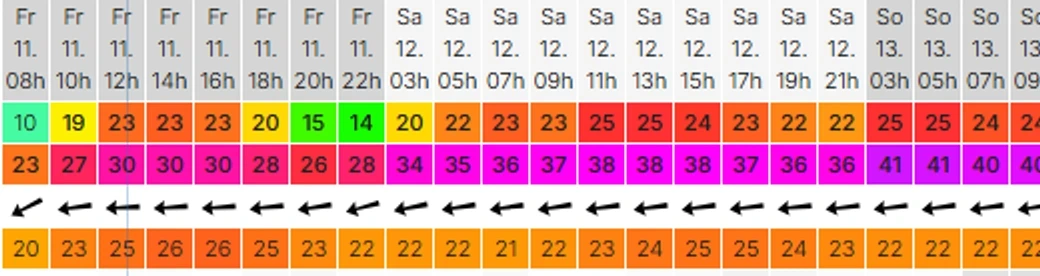
The table everyone here checks in the morning, live at Windguru
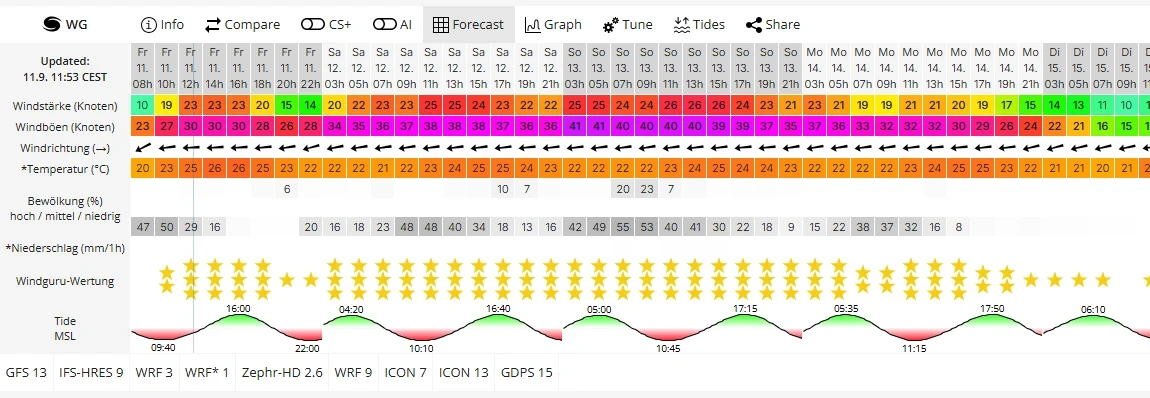
Two models: GFS 13 km for the trend over the next days, WRF 3 km for the local day. How to read the rows is directly below, on an example day.
Windguru for beginners
Reading the table
Windguru row by row, on two typical days: a Levante and a Poniente
Windguru for beginners
Reading the table
Windguru row by row, on two typical days: a Levante and a Poniente
The first time you look at Windguru as a beginner, you see a wall of numbers, colours and arrows — and it makes you nervous. It did the same to us. So we go through the table calmly here, on an example with the same rows as Windguru. The numbers at the start of each row come back in the explanations below.
| 1Day · hour | Levante day | Poniente day | ||||||||||||||
|---|---|---|---|---|---|---|---|---|---|---|---|---|---|---|---|---|
| Time | 07h | 09h | 11h | 13h | 15h | 17h | 19h | 21h | 07h | 09h | 11h | 13h | 15h | 17h | 19h | 21h |
| 2Wind speed (knots) | 19 | 23 | 27 | 30 | 32 | 31 | 27 | 22 | 12 | 14 | 16 | 18 | 20 | 21 | 19 | 15 |
| 3Gusts (knots) | 29 | 34 | 39 | 42 | 44 | 43 | 38 | 31 | 15 | 17 | 19 | 21 | 24 | 25 | 23 | 18 |
| 4Wind direction | ||||||||||||||||
| 5Temperature (°C) | 24 | 26 | 28 | 30 | 30 | 29 | 27 | 25 | 21 | 22 | 23 | 24 | 25 | 25 | 24 | 22 |
| 6Cloud cover (%) | 10 | 10 | 15 | 20 | 25 | 20 | 10 | 5 | 40 | 30 | 20 | 10 | 10 | 10 | 15 | 20 |
| 7Precipitation (mm/h) | – | – | – | – | – | – | – | – | – | – | – | – | – | – | – | – |
| 8Windguru rating | ★★ | ★★★ | ★★★ | ★★★ | ★★★ | ★★★ | ★★★ | ★★★ | ★ | ★ | ★ | ★★ | ★★ | ★★ | ★★ | ★ |
Colours as at Windguru: from light blue (light) through green and yellow to red (strong).
Reading example · Levante day, 3 pm
32 kn, gusts 44, arrow to the left
Twelve knots between mean wind and gusts, direction from the east: a Levante day. Warm, strong, rough close to the shore. What that means for the beach is under “Where to launch”.
Reading example · Poniente day, 3 pm
20 kn, gusts 24, arrow to the right
Four knots of gap, direction from the west: Poniente, even, with waves. The wind Robert’s quote is about. Why it builds on a clear afternoon is under “Thermal wind”.
- Day and hour
- Each column is one hour of the model, not a measurement. Between two columns the wind can do whatever it likes.
- Wind speed (knots)
- The mean wind the model calculates for that hour, not the force you feel in the kite. One knot is one nautical mile per hour, i.e. 1.85 km/h — 20 knots is about 37 km/h, 30 about 55. The Beaufort table below turns the number into a picture of the sea.
- Gusts (knots)
- Read the gap to the mean wind: in Tarifa it says more than the mean itself. That the wind comes in gusts, never perfectly even, is nature. Near the beach the Levante is markedly gustier than the Poniente: it comes off the land and over the mountains, which makes it rough close in, while further out it runs cleaner. The Poniente arrives over the open Atlantic and is softer and more forgiving.
- Wind direction
- The arrow points where the wind blows to: left means from the east, Levante; right means from the west, Poniente. Anything in between is one of the two, veering a little.
- Temperature (°C)
- Air temperature. Together with the wind it decides how thick a wetsuit you want; the water stays cooler than the air for most of the year.
- Cloud cover (%)
- Weather context for the day. Little cloud is no proof of thermal wind. On windguru.cz the same row is split into high, mid and low layers.
- Precipitation (mm/h)
- Modelled rain per hour. A dash means none. Showers often come with sudden wind shifts, which is worth knowing when you plan a session.
- Windguru rating
- The stars are Windguru’s own rating of the wind for its users, based on speed alone. They are not a safety judgement and know nothing about zones, gusts on the beach or your level. A friendly hint, no more.
- Not in this view: wave and period
- For kiting in Tarifa the wind decides, so we leave the wave rows out. In short: wave height is an average of the higher waves, not the one big wave at the shore; the period is the time in seconds between two waves — long means swell with power, short means choppy water, exactly what a Levante against the tide makes. Both are in a wave model on windguru.cz.
The models — and why the locals pick WRF 3 km
For Tarifa, Windguru stacks several weather models one below the other. The first time, that is exactly the moment you give up: which one do I take? Here they are in short, from coarse and long-range to fine and short-range:
- GFS 13 km
- A global model — it computes the whole world, so it stays coarse, on a 13 km grid. Good for the rough trend over several days, too coarse for your beach.
- IFS-HRES 9 km
- The European model, a bit finer at 9 km. A solid middle ground, but not yet tailored to the Strait.
- WRF 3 km
- The local, high-resolution model for the Strait of Gibraltar — a 3 km grid, short-range and close to Tarifa. This is the row the locals check first in the morning.
- WRF 1 km
- Finer still, on a 1 km grid. Finer means more detailed — but not automatically more accurate, more on that in a moment.
Why WRF 3 km of all of them? Because a fine, local grid is what can represent the Strait of Gibraltar in the first place — the coarse global models smooth away exactly the effects that make Tarifa what it is. But watch out for the most common mistake: finer is not automatically more correct. That is why you never read just one row. When two or three models roughly agree on direction, strength and timing, the day is stable. When they diverge, that is the information — the day is uncertain, and you take another look at the beach. The green stars are a nice touch. They will not carry your board to the water.
Putting the knots in proportion: the Beaufort scale
The Beaufort scale is the official way of turning a wind speed into a picture of the sea. It describes the water, not your session.
| Knots | Beaufort | Name | What the sea looks like |
|---|---|---|---|
| 7–10 kn | 3 | Gentle breeze | Small wavelets, crests begin to break |
| 11–16 kn | 4 | Moderate breeze | Small waves, fairly frequent white horses |
| 17–21 kn | 5 | Fresh breeze | Moderate waves, many white horses, some spray |
| 22–27 kn | 6 | Strong breeze | Large waves form, white foam crests everywhere, more spray |
| 28–33 kn | 7 | Near gale | Sea heaps up, foam blown in streaks along the wind |
| 34–40 kn | 8 | Gale | Moderately high waves, crests break into spindrift |
Ranges as used by the World Meteorological Organization. Which force is fun and which is too much is a question for your level, the beach and the day — and for the school if you are unsure.
When AEMET writes “fuerza 7” in a warning, this is the scale it means: 28 to 33 knots, roughly 50 to 61 km/h.
Status open Official warnings for the Estrecho zone: loading …
Official warnings for the Estrecho zone
Loading the official warning status …
The official warning status could not be fetched right now
If the value is missing, the field stays empty; the warnings are directly at AEMET.
:
What the Spanish weather service reports for today
Official AEMET warnings take precedence over any model calculation. We do not summarise them and we do not weigh them against other models. The Estrecho warning zone (611104) has been checked against AEMET’s official zone register; the block above shows AEMET’s wording, and whenever it fails the link leads straight to AEMET.
Loading the official AEMET forecast …
—
High · Low
Rain probability —
—
High · Low
Rain probability —
—
High · Low
Rain probability —
The official AEMET forecast is currently unavailable
When data is missing, the field stays empty; the official forecast and warnings are directly at AEMET.
Open official AEMET forecast and warningsAEMET’s hourly forecast for Tarifa, read for you by fixed rules: what wind, gusts, sea state and sky mean for the hour. Nothing here chooses a spot, names a kite size or approves a session.
Loading the AEMET values …
Now in Tarifa, —
- Wind
- —
- Trend
- —
- Water
- —
- Sky
- —
- Official
- —
Next hours
| Next hours |
|---|
| Wind kn |
| Gusts kn |
| From |
Tomorrow: —
Before the water: actual direction, gusts, sea state, buoys, signage and official warnings. These values describe a forecast hour, never a riding approval.
The live briefing is currently unavailable
We would rather show nothing here than a value we cannot stand behind. The official AEMET forecast above remains available.
Open official AEMET forecast and warningsLevante and Poniente
Which wind
Two wind patterns, two completely different days
Poniente comes from the west, off the Atlantic. On the main beaches it is side-onshore, usually runs more evenly and typically brings waves with it. Levante comes from the east. On the main beaches such as Los Lances it mostly blows side-offshore and is known for strength and gustiness. That is not the same everywhere; stretches like Balneario or Palmones sit differently. So wind direction alone yields neither a choice of spot nor a safety assessment.
Reading the morning before you look at the table

In the morning I can already feel the wind in the temperature: warm usually means Levante, cool brings Poniente. And Levante often needs a day — the first day is fidgety and gusty, the second one really runs.
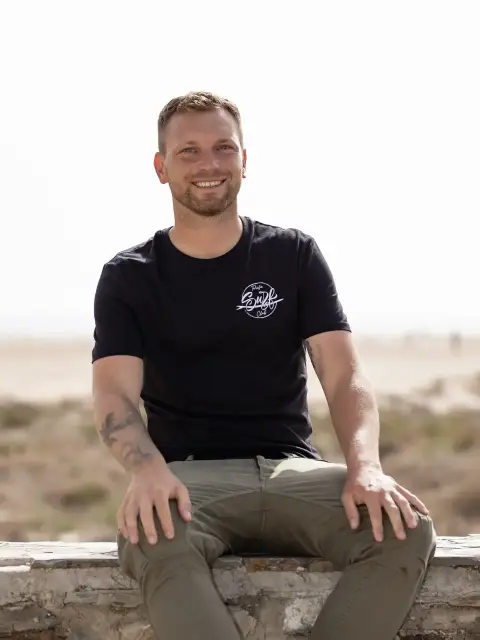
How he can tell a day is running differently from the forecast:
I really only look at the mountains. If that thick Levante cloud is sitting over Gibraltar, the wind stays steady. If the cloud dissolves, the wind usually collapses shortly after. Another good indicator: when everyone out there suddenly loses ground upwind, the tidal current is running off downwind. That steals the pressure from your kite immediately, whatever the app says.
The Tarifa we mean
From my personal experience: Tarifa is advertised with around 300 kite days a year, and yes — some of those are Levante days. Anyone who wants to catch them all has to be able to kite in Levante too.
But the kitesurfing I mean, the kind the locals do here: that is Poniente. Los Lances right outside the door, waves in it, the wind not brutal but strong enough for a lot of fun. For me, that is the Tarifa experience.
That is why I wanted my apartment exactly there — with a view of Los Lances. I can see when the wind arrives. And when it arrives, I pack my things and go out.
How it shows in the table
In the wind-direction row the arrow points left: from the east, Levante. Pointing right, it is Poniente. And in a Levante the gap between wind speed and gusts is wide — exactly what the example day under “Reading the table” shows. Which beach suits which wind is under “Where to launch”.
Sea breeze and land breeze
Thermal wind
Why the Poniente builds on clear afternoons — and the Levante does not
Thermal wind is the push the sun builds up over the day and takes away again in the evening. It comes from land and water warming at different speeds, and on every clear day it follows the same pattern.
Morning
Everything equally cool
After the night, land and sea are at almost the same temperature. Nothing sets air in motion. Whatever blows now is pure Poniente or Levante, with nothing added.
Afternoon
The land pulls air in from the sea
The sun heats the land quickly and the water hardly at all: water absorbs a lot of heat without getting warmer, and mixes it down into the depths. Over the hot land the air rises. Where it rises, air is missing at ground level, and the cool air from the sea flows in — that is the sea breeze. It is strongest when the land is warmest, in the afternoon.
Evening and night
The engine is gone
Without sun the land cools quickly, the difference to the sea shrinks, the sea breeze dies away. At night it weakly reverses: the sea is now the warmer one, and a light land breeze drifts out over the water.
What that means for the Poniente
The Poniente comes off the Atlantic, from the sea — the same direction the sea breeze pulls. On a clear afternoon the two add up, which is why the Poniente often builds after midday. When it clouds over, the sun is missing and the push stays away.
What that means for the Levante
The Levante comes from the other direction, off the land. It gets nothing from this push; it keeps its own clock, and you read that best from Mark’s cloud over Gibraltar. Towards evening it often eases — the last session of the day is frequently the cleanest.
And in the table
Still, thermal wind is not a number you add to the forecast. Anyone calculating “forecast plus a few knots” in the morning is talking themselves into a good day. What you can see in the table: a Poniente that rises from 1 pm to 5 pm with little cloud. That is the thermal push the model has already counted in.
Current in the Strait
Tides and wind
What the current in the Strait does to the wind you feel in the kite
The tide moves the water you ride on, and in the Strait the current runs hard: it turns with the tide, roughly every six hours, and in between it pulls one way. What you feel in the kite is the wind over water that is moving itself.
Current with the wind
When the current runs off downwind, the water carries you away with the wind. The pressure in the kite drops and everyone loses ground upwind, although the table shows the same number. That is the sign Mark describes above.
Current against the wind
When the current runs against the wind, the wind arrives stronger over the water and the water stands up: short, steep, choppy waves, especially in a Levante. More pressure in the kite and rougher water.
In the Windguru table the tide is the curve in the bottom row; on the beach you see it at the waterline. The modelled sea level some weather apps deliver is expressly not meant for the coast and replaces no tide table.
Beach, zones, tide
Where to launch
Which beach suits which wind, and what the buoys say
A forecast describes model values. What you find on the water, you judge yourselves — on the beach, looking at the wind, the sea state and the situation. Do not go out alone, especially not in demanding or offshore conditions. If you are unsure, talk to a qualified local school or to Tarifa Surf Club and go out accompanied or in a group.
Which beach in which wind
What Mark tells guests who want to go out in Levante for the first time:
For a first Levante I send people to Valdevaqueros. The wind sits a bit more onshore there, and the big dune at your back makes a difference. Anyone going out from the main beach at Los Lances in offshore wind has a rescue card in their wetsuit with me — without one I do not ride there. And out there I almost always rig one size smaller than it looks from the shore. The gusts here really do pack a punch.
For the spots and zones in detail we have a page of its own: Kitesurf spots in Tarifa — which stretch works in which conditions, and where the zones run.
What is officially regulated in Tarifa
The basis is the municipal Plan de Explotación de Playas 2024–2027 of the Ayuntamiento de Tarifa. It separates different use areas on the beaches, and that separation is implemented on site through markings, buoys and signage.
Signs, buoys and current instructions on site take priority.
Valdevaqueros
The official plan designates, among other things, bathing areas, areas for free water-sport launch and exit, school areas and separate kite and windsurf areas. The exact boundaries are set on site by the intended markings and buoy lines.
Los Lances Norte
In the official plan this is not one uniformly usable area. There are separate bathing and water-sport areas, plus school and channel areas and ecological protection zones.
Lances Sur Natural and Urbana
For Lances Sur Natural and Lances Sur Urbana we draw no kite boundary of our own. The municipal beach plan and the markings on site are what counts.
The Los Lances lagoon
There is no leeway here. Kitesurfing is officially prohibited in the protected lagoon area. The Junta de Andalucía bases this on protected-area law and on the municipal beach regulations.
In an emergency
Two providers with boats at Los Lances Norte and Valdevaqueros have your back. What their vouchers cover, where you buy the rescue cards online and how you reach the state sea rescue — 112, Salvamento Marítimo 900 202 202, VHF channel 16 — is on a page of its own.
AMARA × Tarifa Surf Club
With the club
Why we send you to Tarifa Surf Club
Mark and I met ten years ago at a Tarifa Surf Club kitecamp, and our shared love of kitesurfing grew into a close friendship. Today Mark runs the club with Simone and we see each other almost every day. What that means for you in practice:
Gear, sorted before you arrive
You can buy or rent kitesurf gear through Tarifa Surf Club before you arrive. The coordination happens in advance. The gear is waiting in the accommodation when you arrive.
The rental deposit
Anyone renting gear normally leaves a deposit with the provider. For AMARA guests, we place that deposit with Tarifa Surf Club.
Course, kitecamp or an accompanied session
If you are still unsure or do not want to go out alone: a course, a kitecamp or an accompanied session are there for exactly that. With booked services of Tarifa Surf Club — kite course, kitecamp, Help to Kite — sea rescue is included. With gear rental alone, it is not.
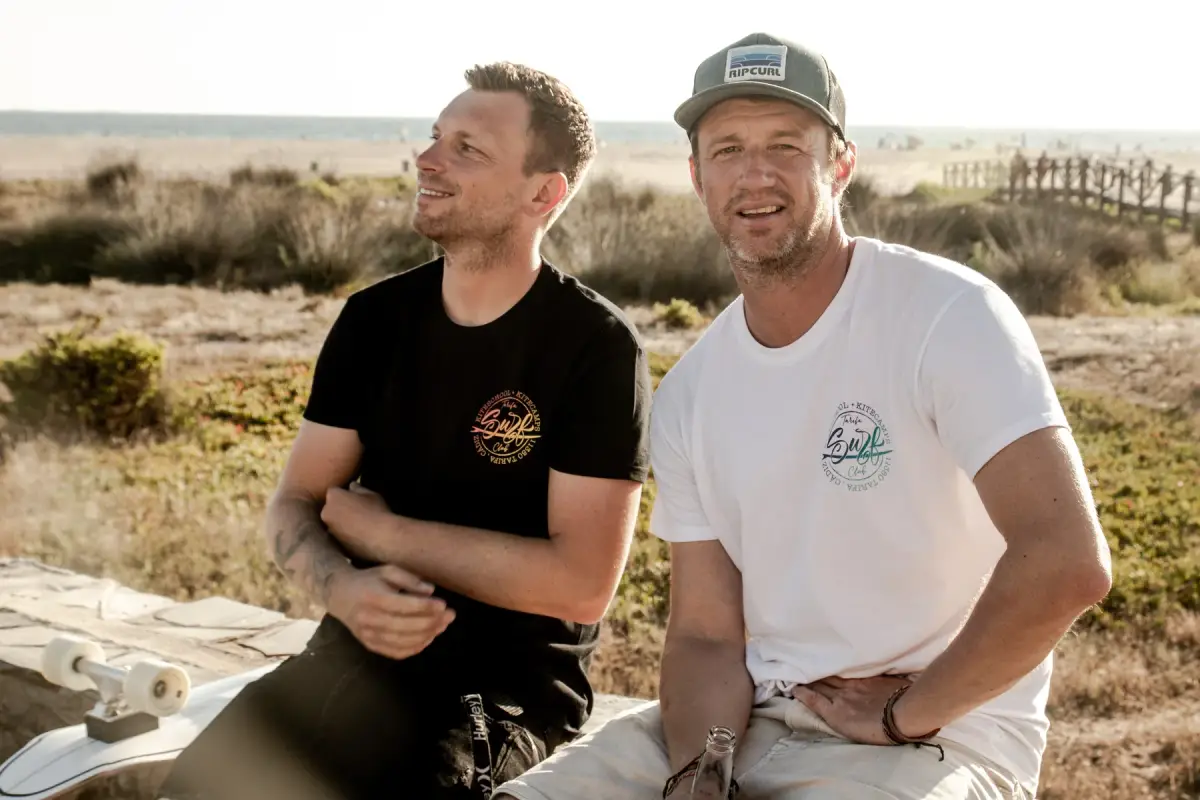
What gets overlooked most often in Tarifa:
The gear. In a proper Levante we ride 4s to 6s here — sizes most people don’t have sitting in the cellar at home. If you’re missing something there, we’re happy to provide it all.
Your direct-booking advantage
What we recommend to friends is in the Guest Guide.
Book directly with us and the AMARA Guest Guide for Tarifa comes with your stay: the addresses we give our friends, and the details that make the day easier.
- Our addresses in Tarifa: restaurants, beaches, walks, some of them only there
- Phone or WhatsApp for reservations
- The way from your front door, in minutes
- What we experienced there ourselves