Nerja · Caves
Five teenagers went looking for bats and found a cathedral
The Caves of Nerja are the most visited thing in the area, and the most misreported. This is what is actually established: who found them, what the record-holding column really is, and why the famous date on the paintings turned out to be wrong.

As of August 2026
Opening hours and prices are with the operator; the link is below.
- Discovered
- 12 January 1959
- Explored length
- 4,823 metres
- The column
- 32 m tall · Guinness record since 1989
- The visit
- 45–60 min · over 458 steps
The find
Bats gave it away
On 12 January 1959 five young men from Maro — Miguel Muñoz, José Luis Barbero, José Torres, Francisco Navas and Manuel Muñoz — squeezed through a narrow karst shaft called La Mina.
They had been watching bats fly in and out of it in the evenings and cleared away the stone formations blocking the way. Behind it lay a system that is now explored to a length of 4,823 metres.
The record
What the Guinness entry actually says
In the Sala del Cataclismo stands a free-standing column formed where a stalagmite and a stalactite grew into one another. The operator gives its height as 32 metres and its base as 13 by 7 metres.
It has held a Guinness World Record since 1989 — not 1994, as is often repeated — and the title is precise: the largest column formed by the merging of a stalagmite and a stalactite.
Calling it "the world’s largest stalagmite" is wrong. Once the two have joined, it is no longer a stalagmite; it is a column. The distinction matters because it is the only claim here that is actually certified.
The paintings
The date everyone quotes was withdrawn
In 2012 a research team dated charcoal found beside the red animal figures to between 42,300 and 43,500 years. That is older than the arrival of Homo sapiens in southern Iberia, so the paintings were proposed as the work of Neanderthals — and, if true, the oldest known art of humankind.
That reading did not survive testing. A 2020 paper in the Journal of Archaeological Science showed that the calcite crusts used for uranium-thorium dating behave as an open system here, producing wildly inverted ages. One layer that sits above an 18,000–20,000-year-old charcoal deposit returned a calculated age of 118,900 years.
José Luis Sanchidrián, who led the original 2012 work, is a co-author of the paper that corrected it. Today the paintings are placed in the Upper Palaeolithic and attributed to Homo sapiens. The Neanderthal thesis is considered closed — which is a better story than the one it replaced, not a worse one.
Visitors walk the Galerías Turísticas: the halls of the Fantasmas, the Belén, the Cascadas, the Cataclismo and the Torca. The Galerías Altas and Galerías Nuevas are closed to the public to protect sinter basins and limit heat and humidity.
The painted chambers are not on the route at all and cannot be seen. They are presented instead through high-resolution scans and virtual reality at the Museo de Nerja on Plaza de España — which is the honest way to visit them.
One practical warning: the route has more than 458 steps up and down, with damp ground in places. It is not accessible, and pushchairs and wheelchairs cannot be taken in.
Before you go
Most of the cave is closed, and that is the point
Getting there
The cave is by Maro, not in central Nerja
From Nerja, the realistic choices are a private car, taxi or a scheduled coach towards the cave and Maro. The operator has parking at the cave site, but current access, charges and opening arrangements should be checked before the visit rather than copied into a permanent guide.
For public transport, use the current operator and Alsa journey information: stops and service patterns can change, and the final walk depends on the service selected. A taxi is the simplest door-to-door alternative when timing, luggage or mobility makes that connection awkward.
The operator’s CuevaTren page currently states that the tourist road train is not available in its products. Do not plan around an old timetable; check the official page again if the service is important to your day.

Our own visit
What we did not expect: flying through the galleries that are closed
Alongside the walking route there is a VR experience called “El Gran Viaje Interior”. We did not pay anything extra for it, and we nearly walked past it. That would have been a mistake.
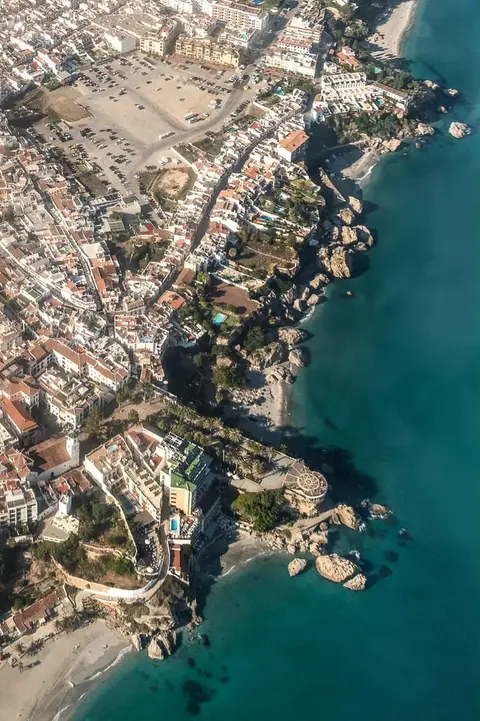
You sit down, put on a headset, and the film first takes you over Nerja from the air — genuinely striking footage — then shows how the cave was formed, and finally flies you through galleries visitors are not allowed to enter. It runs about twelve minutes, and because it is filmed in 360 degrees you look wherever you want while you move. That is what makes it work: you are not watching a film, you are turning your head in a place you will never stand in.
The cave itself does the rest. It stays cool inside — nine degrees, we were told — which in high summer is the most pleasant hour of the day. And on one of the rare days when it rains, this is the one thing on this coast that does not care about the weather.
Continue
Around the caves
Your direct-booking advantage
What we recommend to friends is in the Guest Guide.
Book directly with us and the AMARA Guest Guide for Nerja comes with your stay: the addresses we give our friends, and the details that make the day easier.
- Our addresses in Nerja: restaurants, beaches, walks, some of them only there
Explore further
Links to look into it yourself
Measurements and access come from the cave operator and public bodies, the dating history from the peer-reviewed literature.
As of August 2026
Back to the stay
An hour underground, and the rest of the day is still yours.
The caves sit four kilometres east of the centre. From our door it is a short drive there and a shorter walk back to the sea.