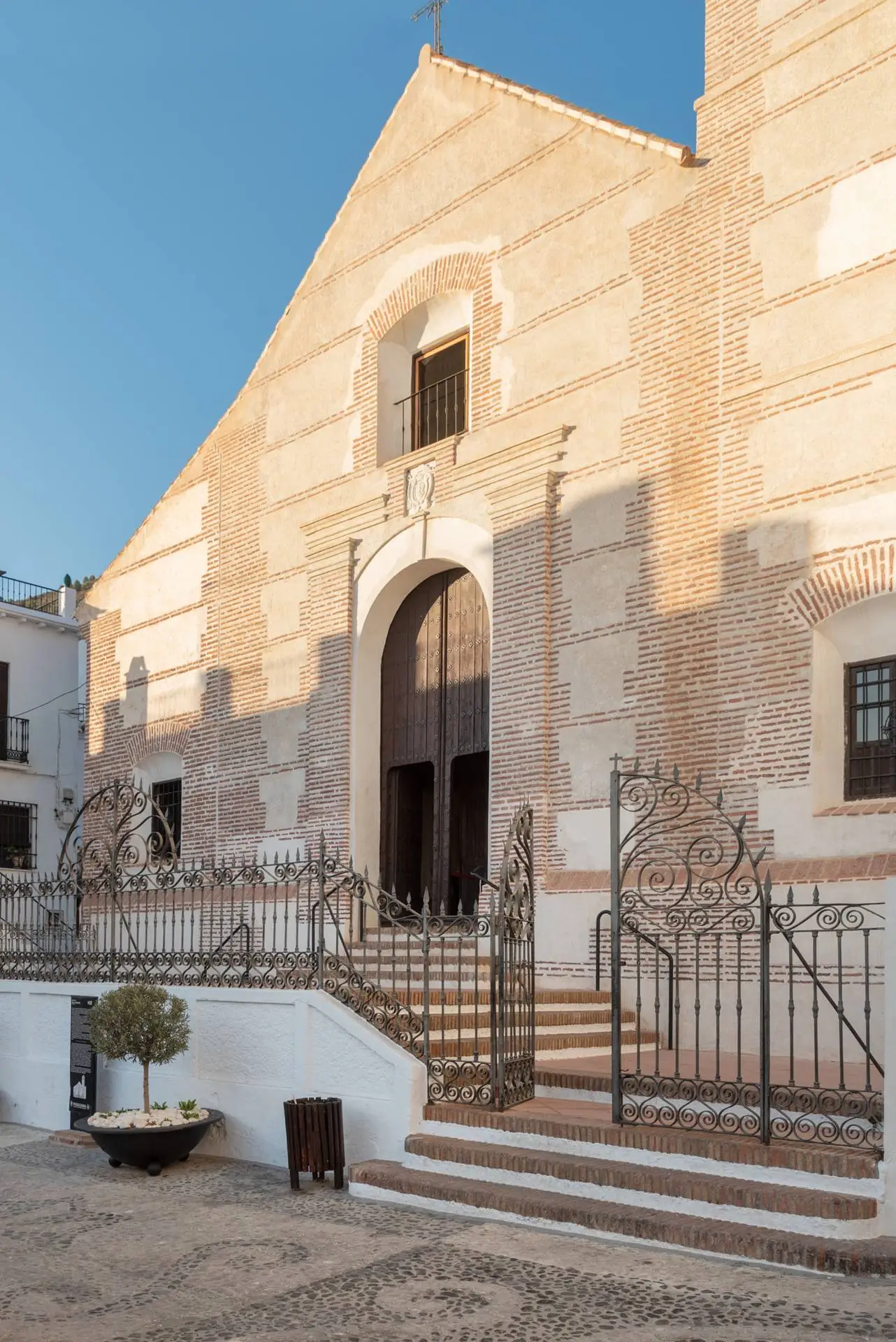
Old town · San Antonio de Padua
Iglesia de San Antonio de Padua
The plain Baroque church that anchors the lower old town
Beside Calle Real, where the lanes of the lower old town gather, stands San Antonio de Padua — the parish church, built in 1676 on the site of an older hermitage. It was raised under the master builder Bernardo de Godoy and promoted by the Bishop of Málaga, whose coat of arms still marks the entrance. From outside it reads as a simple whitewashed volume; step in and the three naves open under a timber roof in the Mudéjar tradition. It is a working church, so opening times follow the parish — check on the day.
- 1676
- Built on the site of a former hermitage
- B. de Godoy
- Master builder “from the foundations”
- 3 naves
- Latin-cross plan, Mudéjar timber roof
- Barock
- Official heritage classification
Dating, authorship and style from official and heritage sources; interior access and service times are current checks, not fixed facts.
The build
1676, from the foundations up
The present church went up in 1676, on ground that had held an earlier hermitage. Its master builder was Bernardo de Godoy, who worked for the bishopric of Málaga; the work was promoted under Bishop Fray Alonso de Santo Tomás, and his coat of arms was set on the entrance façade. That the church we see is a deliberate seventeenth-century build, not a slow accretion, is the single fact that makes the rest legible.
“Bernardo de Godoy, master builder, made me from the foundations, in the year 1676.” — the church’s own signed roof beam
The plan
Three naves under a timber roof
Inside, the church follows a Latin-cross plan: three naves divided by semi-circular arches, closing on the crossing. Overhead runs a timber roof in the Mudéjar tradition — an armadura, the carpentry that Andalucía kept building long after the styles around it changed. That timber ceiling is a construction habit, not a competing style: the building is officially classified as restrained Baroque of the late seventeenth century, which supersedes the older habit of calling it Renaissance.
Today
A landmark you meet, not a museum you tour
San Antonio is still the parish church, and that shapes how you meet it. It stands where the lower old town gathers, a short walk below Casa AMARA, and it is the easiest fixed point to steer by on a walk up through the lanes. Whether the doors are open depends on services and the parish calendar rather than fixed visiting hours, so treat the interior as a matter of luck and timing — the façade, the bishop’s arms and the position beside Calle Real are yours at any hour.
Your direct-booking advantage
What we recommend to friends is in the Guest Guide.
Book directly with us and the AMARA Guest Guide for Frigiliana comes with your stay: the addresses we give our friends, and the details that make the day easier.
- Our addresses in Frigiliana: restaurants, beaches, walks, some of them only there
- The way from your front door, in minutes
Find it on an old-town walk
San Antonio stands at the foot of the old town, minutes above Casa AMARA. Let it be your fixed point, then follow the lanes up to El Ingenio, the Casa del Apero and the ceramic panels.