Old town · Fuente Vieja
Fuente Vieja
The old fountain that watered the village for centuries
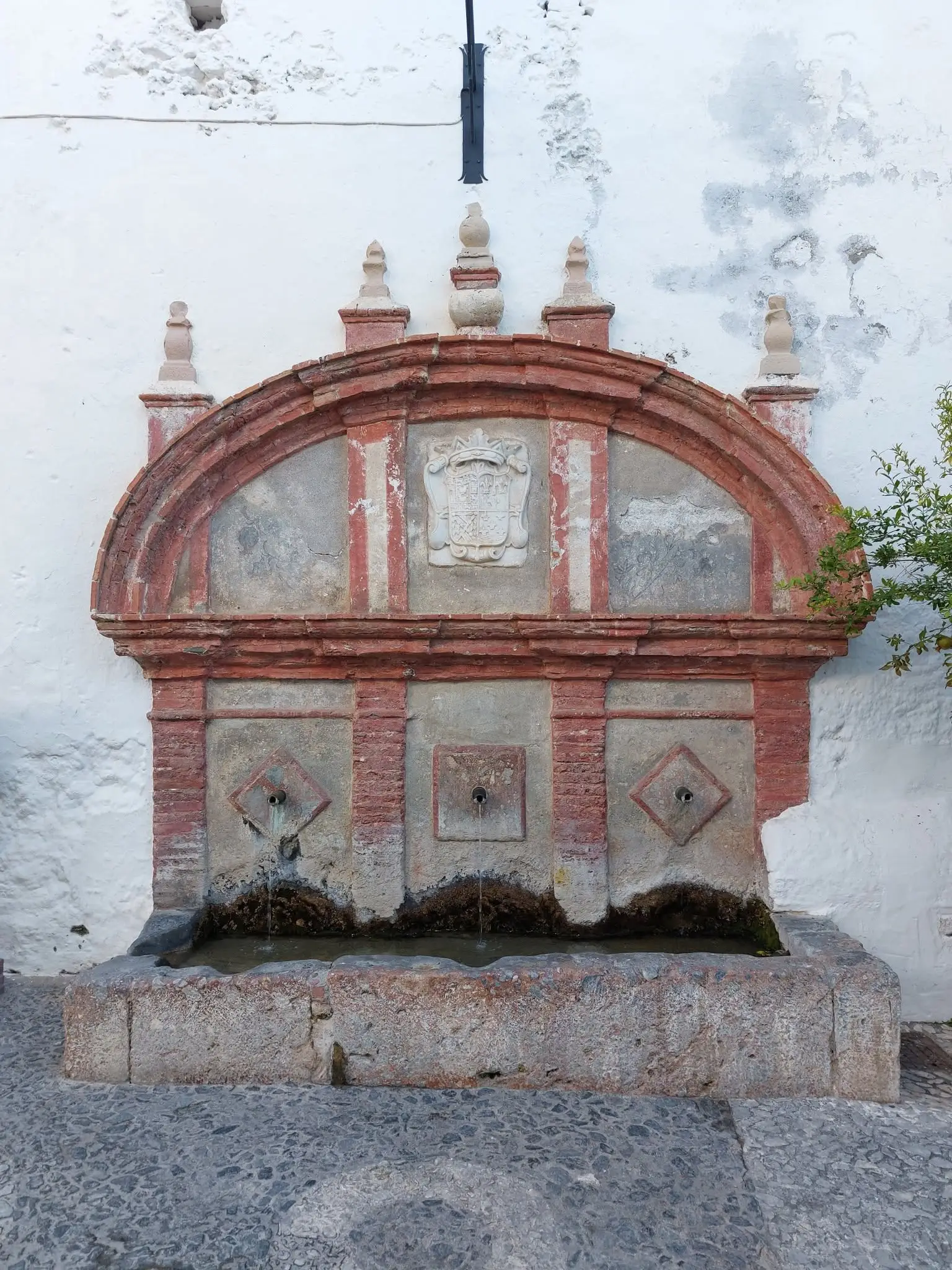
On the plaza that bears its name stands the Fuente Vieja, built around 1640 by Don Íñigo Manrique de Lara, fifth Señor and first Count of Frigiliana. Its two-storey stone front carries the counts’ coat of arms in the central field of the upper body, and three spouts still run into the trough below — which once doubled as the village animal trough. Into the nineteenth century this was a central point of the water supply, where people filled their jars, and it makes a quiet historic corner at the edge of the old town.
- ~1640
- Built by Don Íñigo Manrique de Lara
- 5./1.
- Fifth Señor and first Count of Frigiliana
- Escudo
- The counts’ coat of arms, upper central field
- 3 caños
- Three spouts, once also an animal trough
The c.1640 dating, the fifth-Señor/first-Count attribution and the "Fuente Nueva" origin name are confirmed by the municipal history and the local heritage record; the 1990s restoration is attested by the Andalusian fountain inventory.
The build
Built by the lords of the village
The fountain dates from around 1640 and was raised by Don Íñigo Manrique de Lara, fifth Señor and first Count of Frigiliana — the same family whose palace-turned-sugar-works, El Ingenio, still stands nearby. It was first called the "Fuente Nueva", the new fountain, and only became the "old" one once newer fountains were built elsewhere. The two-storey stone body, its pilasters and semicircular pediment with pomegranate motifs, and the coat of arms set into the upper central field are all of a piece: public infrastructure built as a statement, with the lords’ name written into the stone above the water they provided.
For generations, this is where the whole village’s water arrived.
The water
Where daily life gathered
For centuries the Fuente Vieja was the practical heart of daily life: the main source of water for the households and their animals, the place you came to fill jars and troughs before piped water reached the houses. Its three spouts still run, and standing in front of it is the quickest way to feel how much of a hillside village’s day once turned around fetching water.
Where to find it
On the Plaza de la Fuente Vieja
The fountain stands on the small plaza that takes its name, off a branch of Calle Chorruelo near the Ermita de Ecce Homo, at the edge of the old town. That makes it a natural turning point on a walk — pair it with the tiny chapel a step away, then work back up through the lanes. Take a moment with the coat of arms; restored in the 1990s, the stone still shows the wear of the centuries it served.
Your direct-booking advantage
What we recommend to friends is in the Guest Guide.
Book directly with us and the AMARA Guest Guide for Frigiliana comes with your stay: the addresses we give our friends, and the details that make the day easier.
- Our addresses in Frigiliana: restaurants, beaches, walks, some of them only there
- The way from your front door, in minutes

Make it a turning point
The Fuente Vieja is a short walk down through the old town from Casa AMARA. Reach it at the village edge, then let the lanes carry you back up past San Antonio, El Ingenio and the ceramic panels.