Old town · The ceramic panels
The twelve ceramic panels
A walk through 1569 — and what it leaves out
Set into the walls of the upper quarter, twelve hand-painted panels tell the story of the Morisco revolt of 1569 in sequence. They look old, but they were made in 1982. Knowing who wrote them, who fired them and where their story parts from the documented record makes the walk far more interesting — not less.
- 12
- Hand-painted panels
- 1569
- The revolt they retell
- 1982
- Installed — not old
- 4
- Mineral colours, like the 16th century
Provenance from the official booklet and commissioned research; the panels are 1982 memory culture, not primary evidence for 1569.
The story
What happened in 1569
To read the panels, it helps to picture the situation. After the fall of Granada, the Muslims of the Sierra de Bentomiz stayed on as baptised “Moriscos”, keeping their own language, dress and customs. A royal decree forbade all of it, and year by year the pressure and the fear grew.
In 1569 the villages rose. Thousands from the region gathered on the Peñón, the steep rock above Frigiliana, on which they pinned their hopes. In June the crown came with an army and a fleet; the rock fell, and the old world of the sierra came to an end. The twelve panels tell exactly this arc — from the land to the last silence.
They look old — and were made in 1982.
Where they come from
Where the panels come from
The panels did not grow over centuries. They are a deliberate act of 1982 — a piece of public history built into the streets, with named authors and a clear technique.
Installed in 1982
The twelve panels were put up in 1982, during the upgrade of the old Morisco quarter that coincided with Frigiliana’s national beautification award (Premio Nacional de Embellecimiento). They were part of turning a purely architectural quarter into a readable story.
The texts: Antonio Navas Acosta
The panel texts were written by the local historian Antonio Navas Acosta, who reworked the sixteenth-century royal chronicles into a public, victim-facing telling. His book on the subject came later (1995/1999); the panels rest on his earlier research.
The ceramics: Amparo Ruiz de Luna
The ceramic work of the twelve route panels is attributed to the ceramist Amparo Ruiz de Luna. (Sources also link the painter Pilar García Millán to Morisco ceramic work in Frigiliana, probably a separate mural — we keep the two apart.)
Only four colours
The panels use only four mineral colours — ivory white, black, green and brown — copying the sixteenth-century Morisco ceramics of the Bentomiz region and avoiding costly imported blue and red. That restraint is why they seem to have always been there.
The walk
The twelve panels, in order
The route begins with panel 1 in Calle Hernando El Darra, near the old grain stores and El Ingenio, and climbs into the Barribarto. Below, each panel’s scene with its full Spanish text — tap to read the original.
All twelve stops sit on the official route: it begins at panel 1 near the Plaza del Ingenio and runs through the lanes of the Barribarto to panel 12 by the church. From Casa AMARA, down by the church, you reach the start in a few minutes.
-
La Tierra
The setting: the fertile Sierra de Bentomiz, its clear air and hardy people, and its twenty-two populated places — Frigiliana among them.
Read the text: translation & original
The Sierra de Bentomíz lies within the lands of the town of Vélez. All this fertile country is covered with woodland and rich in cool, wholesome waters that run down between the crags. Its sky is so clear that, making the land delightful, it breeds men so nimble, tough and high-spirited that in former times the Moorish kings held them to be the bravest, the most agile and the most effective in the whole kingdom of Granada. It had twenty-two places peopled by prosperous folk — Frigiliana among them.
Original Spanish text
«La Sierra de Bentomíz cae en los términos de la ciudad de Vélez. Toda esta tierra fértil poblada de muchas arboledas, abundante de aguas frías y saludables que baxan entre las peñas. Alcanza un cielo tan claro, que haciéndola amenísima, cria los hombres ligeros, recios y de tan grande ánimo, que antiguamente los Reyes Moros los tenían por los más valientes, más sueltos y de mayor efeto que había en el reyno de Granada. Tenía veinte y dos lugares poblados de gente rica, entre ellos, Fragiliana».
-
La Gente
A settled life turns to fear as the 1567 decree bans the Morisco language, dress, music, feasts and gatherings.
Read the text: translation & original
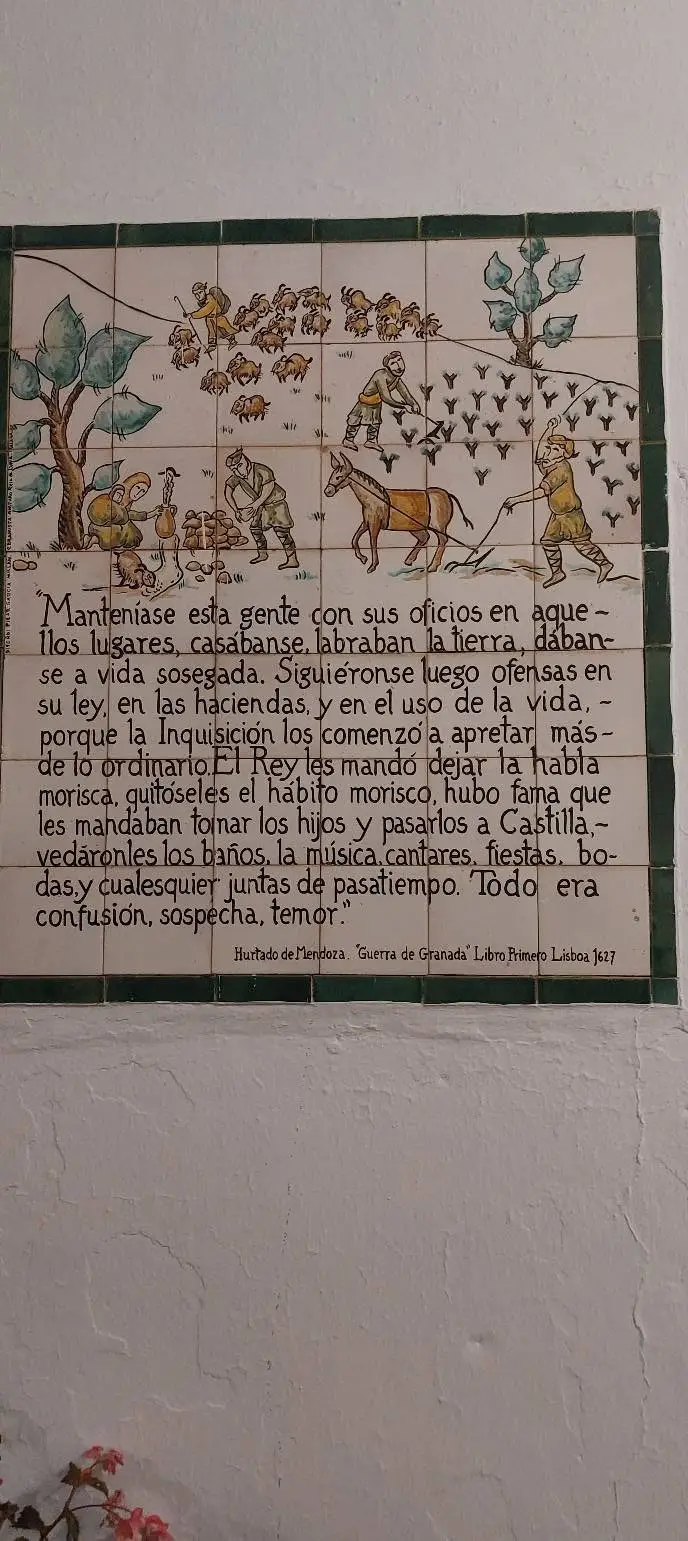
These people supported themselves by their trades in those villages; they married, worked the land and led a quiet life. Then came offences against their faith, their property and their way of living, as the Inquisition began to press them harder than usual. The King ordered them to give up the Morisco tongue; their Morisco dress was taken from them; it was rumoured that their children would be taken and sent away to Castile; they were forbidden their baths, their music, their songs, feasts, weddings and every gathering for pleasure. All was confusion, suspicion and fear.
Original Spanish text
«Manteníase esta gente con sus oficios en aquellos lugares, casábanse, labraban la tierra, dábanse a su vida sosegada. Siguiéronse luego ofensas en su ley, en las haciendas, y en el uso de la vida, por que la Inquisición los comenzó a apretar más de los ordinario. El Rey les mandó dejar la habla morisca, quitóseles el hábito morisco, hubo fama que les mandaban tomar los hijos y pasarlos a Castilla, vedáronles los baños, la música, cantares, fiestas, bodas y cualesquier juntas de pasatiempo. Todo era confusión, sospecha y temor».
-
La Revuelta
Escalation: the outlaw Andrés el Chorairán stirs revolt; a moderate who tried to stop it is jailed and tortured with the innocent.
Read the text: translation & original
Andrés el Chorairán, an outlaw from Sedella, stirred up his people to rouse them to revolt. The young men who were beginning to riot were held back by the Morisco Luis Méndez, an influential man in Canillas, but he could not stop them from attacking the inn of a Christian and killing several people there. The judge of Vélez, Pedro Guerra, arrived, and many innocent Moriscos — among them Luis Méndez, who had prevented the uprising — were seized, loaded with chains and subjected to cruel torture.
Original Spanish text
«Andrés el Chorairán monfí natural de Sedella, concitó los ánimos de los suyos para escitarles a la rebelión. La gente moza que comenzaba a alborotarse la contuvo el morisco Luis Mendez, hombre influyente en Canillas, pero no pudo evitar que atacaran una venta de un cristiano, ni que mataran en ella a varias personas. Acudió el Juez de Vélez Pedro Guerra y muchos inocentes moriscos, entre ellos Luis Mendez que había impedido la revuelta, fueron presos y cargados de cadenas y sometidos a crueles tormentos».
-
Los Jofores
Prophecy and pilgrimage: an elder invokes Allah’s protection and urges the people not to abandon their lucky ground.
Read the text: translation & original
Days later they went in pilgrimage to the hermitage (rábita) of Canillas to beg for the protection of Allah, and the old Muslim addressed the crowd, urging them not to abandon the place. When, at one point in the uprising, the Moriscos decided to leave it and join those at a safer place, the Peñón de Frigiliana, an old man, the Jorrón de Leimón, protested against the decision, for he said that this had been a fortunate place, where the Moors had always met with happy fortunes.
Original Spanish text
«Días después trasladáronse en romería, almorabito de la Rábita de Canillas para impetrar la protección de Alá y el viejo musulmán dirigió la palabra a la muchedumbre, exhortándoles a que no abandonasen el lugar. Cuando en un momento de la sublevación los moriscos decidieron abandonarlo para unirse a los de otro lugar más seguro, el peñón de Frigiliana, un viejo, el Jorrón de Leimón, protestó del acuerdo, porque decía que aquel había sido lugar dichoso, donde habían tenido siempre, felices sucesos los moros.»
-
La Identidad
The old banner with green crescents reappears; the noble Martín Alguacil is raised on a white mule as a leader.
Read the text: translation & original
The village had scarcely risen when there appeared in the square a banner of red taffeta, already faded with age, bearing very large green crescents — kept until then by Francisco de Rojas, a Morisco of that place, to whom it had come from his forebears in the time of the Moors. With the people of Canillas de Aceituno risen, those of Cómpeta, moved by Martín Alguacil, a noble man of great authority, took up arms; and dressing him in rich sashes of silk and gold, they set him on a white mule, and all came to kiss his hand and his robe.
Original Spanish text
«Aun no era bien acabado de alzar el pueblo, cuando pareció en la plaza del lugar una bandera de tafetán colorado, ya deslucida de vieja, con unas lunas verdes muy grandes, que la tenía guardada Francisco de Roxas, Morisco de aquel lugar, que había sido de sus pasados en tiempo Moros. Alzados los vecinos de Canillas de Aceytuno; los de Cómpeta movidos por Martín Alguacil, hombre noble y de mucha autoridad, tomoaron las armas, y ataviándole con ricos almayzares de seda y oro, le pusieron sobre una mula blanca y llegaron todos a besarle la mano y la ropa».
-
El Éxodo
Late April 1569: a mass of people abandon their homes and set out for the Peñón — the panel jumps straight to the defeat of 11 June.
Read the text: translation & original
In the last days of April 1569, this great mass of people — the doors of their houses shut, their homes abandoned, the farmsteads, fields and hamlets left empty — set out for Frigiliana carrying their belongings, tools and weapons. We can only imagine the great cloud of souls outlined on the heights of the Mayarín, crossing hills and streams, on the sad path that would lead them to death and defeat. Reaching Frigiliana, they settled on the ridge of the Fort, where on 11 June, the feast of St Barnabas, they were attacked by the Christians.
Original Spanish text
«En los últimos días de Abril de 1569, esta gran concentración humana, cerradas las puertas de sus casas, abandonados sus hogares, despobladas las alquerías, campos y caseríos, portando sus ajuares, herramienatas y armas, puso rumbo a Frigiliana. Sólo nos resta imaginar la gran polvaredas de almas destacada en las alturas del Mayarín, atravesando cerros y arroyos, camino de la triste senda que los conduciría a la muerte y la derrota. Llegados a Frigiliana se instalaron en la Cordillera del Fuerte, donde el 11 de Junio, día de S. Bernabé, fueron atacados por los cristianos».
-
Los Adalides
The defenders gather on the strong Peñón near the sea and name Hernando el Darra — descended from the village’s former alcaides — their commander.
Read the text: translation & original
And thinking they would be better all together on the Peñón de Frigiliana, which was very strong and near the sea, they sent word to those in the fort of Sedella to come and join them; and they named as their leader and captain-general Hernando el Darra, who was held among them to be very noble, because his forebears in the time of the Moors had been the alcaides and bailiffs of Frigiliana.
Original Spanish text
«Y pareciéndoles que estarían mejor todos juntos en el Peñón de Frigiliana, que era muy fuerte, y cerca del mar, enviaron a decir a los del fuerte de Sedella, que se viniesen a juntar con ellos; nombraron por su caudillo y capitán general a Hernando el Darra, que tenía entre ellos opinión de muy noble, porque sus pasados en tiempo de Moros eran alcaydes y alguaciles de Fregiliana.»
-
Los Cristianos
The crown’s overwhelming force: the naval commanders Requesens, Bazán and Leiva, and 6,000 men including 800 marines.
Read the text: translation & original
Naval forces took part in the undertaking under don Luis de Requesens, don Álvaro de Bazán and don Sancho de Leiva. That fleet contributed effectively to the success of the expedition, aiding operations as brilliant as that of the Peñón de Frigiliana, a position held to be impregnable; and Requesens attacked them at the head of 6,000 men, among whom were 800 marines.
Original Spanish text
«En la empresa tomaron parte fuerzas de mar a las órdenes de don Luis Requesens, de don Álvaro de Bazán y de don Sancho de Leiva. Esa Armada contribuyó eficazmente al buen éxito de la expedición, cooperando a operaciones tan brillantes como la del Peñón de Frigiliana, posición tenida por inexpugnable, y los acometió Requesens al frente de 6.000 hombres, entre los cuales se contaban 800 marinos».
-
El Asedio
Asymmetric defence: the Moriscos roll prepared millstones down the steep slope, cutting through the climbing soldiers.
Read the text: translation & original
The Christian banners began to climb the slope in all haste, but the Moors set about defending the ascent, hurling down many stones by a devilish device: they had readied many millstones, run through the eye with very long beams, and these they rolled straight down onto the Christian squads climbing the slope; and there was not one of these wheels that did not carry off fifty soldiers on its way, if it found them in its path.
Original Spanish text
«Las Christianas vanderas comenzaron a subir a toda priessa por la cuesta arriba, mas los Moros comenzaron a defender la subida, arrojando muchas piedras con una endiablada invención, y fue que tenían muchas ruedas de molino apercibidas, y por los ojos atravesados unos maderos muy largos, y estas arrojaban en derecho de las Escuadras de los Christianos que subían por la cuesta, y no avía rueda destas, que no se llevasse de camino cincuenta Soldados, si delante los hallaba».
-
Las Moriscas
The women fight beside the men and, seeing the fort lost, throw themselves from the cliffs rather than be enslaved.
Read the text: translation & original
There were some Moorish women who fought like valiant men, helping their husbands, brothers and sons; and when they saw the fort lost, they threw themselves from the harshest crags, choosing rather to die dashed to pieces than to fall into the hands of the Christians. Others did not lack the courage to save themselves with their children on their shoulders, leaping like goats from rock to rock.
Original Spanish text
«Hubo algunas Moras que pelearon como esforzados varones, ayudando a sus maridos, hermanos y hijos: y quando vieron el fuerte perdido, se despeñaron por las peñas más agrias, quiriendo más morir hechas pedazos, que venir en poder de Christianos. A otras no les faltó ánimos para ponerse en cobro con sus hijos en los hombros, saltando como cabras de peña en peña».
-
La Diáspora
The toll: around 1,800 dead and some 3,000 taken as slaves — “all paid for in Christian blood”.
Read the text: translation & original
The fort taken and sacked, more than three thousand souls were made captive. Within the fort five hundred men died, most of them old; women and children almost one thousand three hundred. More than six hundred Christians were wounded, and over three hundred soldiers died in the fighting. The plunder was great, and many Moorish women and boys were taken as slaves — though all of it was paid for in Christian blood.
Original Spanish text
«Ganado y saqueado el fuerte fueron captivas más de tres mil almas. Dentro del fuerte murieron quinientos hombres, la mayor parte viejos; mujeres y niños casi mil y trescientos. Cristianos fueron heridos más de seiscientos, muriendo en pelea pasados de trescientos soldados. El saco fué grande y se tomaron esclavos muchas moras y muchachos, aunque todo fué cobrado a precio de christiana sangre».
-
El Holocausto
Silence over the village, and Martín Alguacil’s words on dying for the homeland. The title itself is a deliberate modern choice.
Read the text: translation & original
An anguished silence fell over the hamlet of Frigiliana. There remained the abandoned mountain, the dead bodies, and the living voice of Martín Alguacil: “If, defending our freedom, we should die fighting, the mother earth will receive what she brought forth; and whoever lacks a grave to hide him will not lack a sky to cover him. God forbid it be said that the men of Bentomiz did not dare to die for their homeland.”
Original Spanish text
«Un angustioso silencio se hizo sobre la alquería de Frigiliana. Allí quedaba el monte abandonado, los cuerpos muertos, la voz viva de Martín Alguacil: "Si defendiendo nuestra libertad muriésemos peleando, la madre tierra recibirá lo que produxo; y al que faltare sepultura que le esconda, no le faltará cielo que le cubra. No quiera Dios que se diga que los hombres de Bentomiz no osaron morir por su patria"».
Memory vs. record
Where the panels and the record differ
The panels are memory culture, not a neutral archive. They rest on real chronicles — Luis del Mármol Carvajal and Diego Hurtado de Mendoza — but they shape the story for effect. Three differences are worth knowing.
The 28 May 1569 assault is left out
The panels compress the siege to the decisive royal assault of 11 June. The documented record has two stages: a first royal attack on 28 May 1569 that the Moriscos repelled, and only then the far larger 11 June assault that broke them. The panels drop the Morisco defensive victory for a cleaner arc of doom.
“Holocausto” and “patria” are modern words
The twelfth panel is titled “El Holocausto” and has Martín Alguacil die for the “patria”. Both are twentieth-century terms, foreign to the sixteenth-century actors, who thought in rebellion, punishment and pacification. The choice marks the panels as a 1982 memorial, made as Andalusia distanced itself from centralist history.
The moral is inverted
The chronicles were written from the crown’s side, about rebels to be punished. The panels keep the facts but flip the judgement: the Moriscos become tragic defenders of freedom and homeland. That is a fair, deliberate reinterpretation — worth reading as such rather than as a neutral record.
Your guest extra
The twelve panels as an audio guide — for our guests
Book with us directly and the AMARA Guest Guide gives you a spoken story for each of the twelve panels: stand in front of a panel, press play, and hear what happened here instead of reading a few lines — with the exact walking route from your front door.
- A listening piece of about a minute and a half for each of the twelve panels, in your language
- Playable right there on the spot, with the text to read along
- The exact walking route from Casa AMARA, a few minutes to the start

Walk it, then read the rest of the old town
The panels are the thread; the old town around them is the cloth. From Casa AMARA in the lower centre you reach the start of the route in a few minutes.